Public Space Democracy : Performative, Visual, Normative Dimensions of Politics in a Global Age
Project financed by NOMIS Foundation
« La singularité quelconque, qui veut s’approprier de l’appartenance même, de son propre être-dans-le-langage et décline, pour cette raison, toute identité et toute condition d’appartenance, tel est le nouveau protagoniste, ni subjectif ni socialement consistant, de la politique qui vient. Partout où ces singularités manifesteront pacifiquement leur être commun, il y aura un Tiananmen et, un jour ou l’autre, les chars d’assaut apparaîtront. »
Postface de Giorgio Agamben pour la traduction italienne de La Société du spectacle, Guy Debord, publié en 2008.
« While isolation concerns only the political realm of life, loneliness concerns human life as a whole. Totalitarian government, like all tyrannies, certainly could not exist without destroying the public realm of life, that is, without destroying, by isolating men, their political capacities. But totalitarian domination as a form of government is new in that it is not content with this isolation and destroys private life as well. It bases itself on loneliness, on the experience of not belonging to the world at all, which is among the most radical and desperate experiences of man. »
Hannah Arendt, Totalitarianism: Part Three of The Origins of Totalitarianism, Florida, Harvest Books, 1968, p.173.
Public space is the place for assembly of people, empowerment of persons. It is the hub of democracy as well as the manifestation of state power. PublicDemoS Project explores the ways in which new forms of public agency extend politics to everyday life experiences opening up avenues of artistic expressions and aesthetic forms. The core aim of this project is to renew democratic agendas by politics of performative citizenship and public making in multicultural settings.
Project directed by Nilüfer Göle (2016-2019)
Financed by NOMIS Foundation and hosted by EHESS


The PublicDemoS project generates three different outcomes:
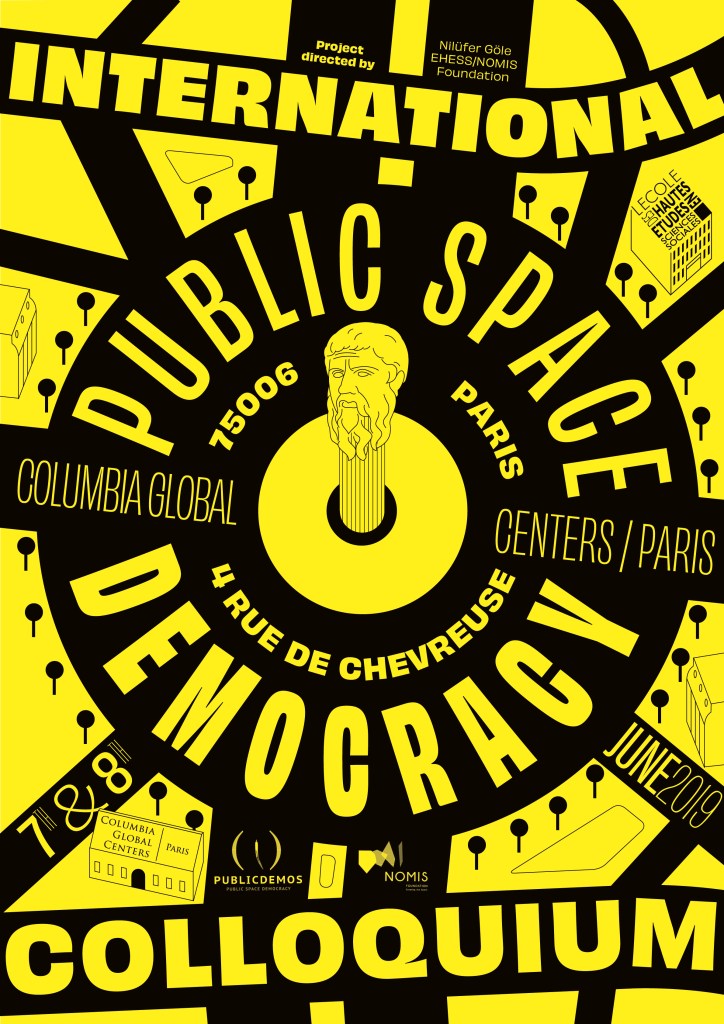
A final colloquium titled « Public Space Democracy: Performative, Visual, Normative Dimensions of Politics in a Global Age » took place at the Columbia Global Center in Paris on June 7th and 8th, 2019. The soundcloud of the colloquium is available online : https://soundcloud.com/columbiaglobalcenters/sets/international-colloquium-on
An edited volume grew out of the eight international study groups and the final colloquium of the PublicDemoS project is published by Routledge in 2022.
Edited volume by Nilüfer Göle, Routledge 2022
This volume takes a global view of the emergence of public protest movements over the last decade, asking whether such movements contribute to the globalization of civil society. Through a variety of studies, organised around the themes of public agency, public norms, public memory and public art, it considers the tendency of political contestations to move beyond national boundaries and create transnational connections. Departing from the approaches of social movements perspectives, it focuses on public space as a site of social « mixity » and opens up a new field for the study of politics and cultural controversies. An analysis of the paradigmatic change in the way in which society is made and politics is conducted, this study of the new enactment of citizenship in public space will appeal to scholars of sociology, anthropology, geography and politics with interests in protest movements and contentious politics, citizenship and the public sphere, and globalization.
A podcast of the project has been realised by Sean Sanders for the Science Magazine in March 2022 with Nilüfer Göle, Sarah Dornhof, Nadia Fadil, Gökçe Tuncel and Boyan Znepolski: https://www.science.org/content/webinar/public-space-democracy-project-reclamation-public-spaces-contemporary-democracy
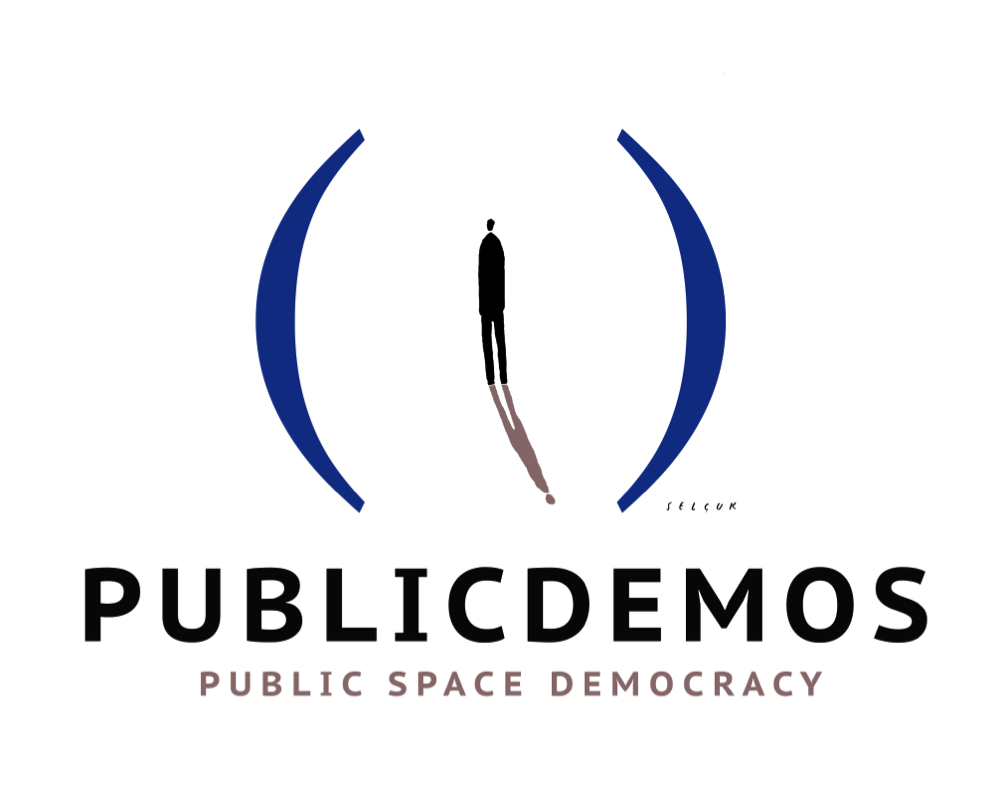
The Logo of PublicDemoS


« It makes me think about social movements. As if social movements were a parenthesis in the course of history and it is up to each person to leave his mark. It’s individual. For this to be a collective action, it is up to everyone to mobilize. So this shadow of this person standing alone, I perceive it as his trace. He alone must act, he must do something. He must take control of the situation. He must either go up or down. » – Elina Kourempana, PhD candidate, EHESS.
I see it like a zone of existence. That is to say that when someone enters our space, we can feel the violation. This is the area of expression but also the zone of respect for being. The zone of existence that we can have in any interaction: someone who will come very close to us who enters our space. There we can say that it is his space to be. – Louise Eymard, student, EHESS.
A lonely man put in parentheses. Feeling of suffocation. When we read PublicDemos, Public Space Democracy, we say that it’s the action that has to change that: lift parentheses so that there are people. Unconventional containment of parentheses compared to humans and shadow. -Sanjay, designer.
The logo as a scientific tool
After a series of exchanges with Selçuk Demirel, the designer of the Logo, we opted for the version that favored the scientific framework of the project and did not duplicate the stereotype images and ideas of public demonstrations.
The private-public distinctions, the link between democracy and public sphere mean different things to researchers coming from different historical political legacies, cultural settings and disciplinary backgrounds. In order to create a common language, we used our Project’s Logo to tease and open up new conceptual horizons over the notion of Public space.
Logo represented a single person standing in the midst of a parenthesis. The presence of a single person instead of a collective protestation triggered discussion. For some, the single person stood for the solitude and vulnerability of citizens in today’s democracies, for others it called for responsibility of the individuals. Furthermore it also facilitated to distinguish personal forms of agency and not to equate public protests always with collective mass action. The parenthesis suggested the frontiers of a space both as a closed regulated sphere but also with a potential for openness. The single man reminded also the “standing man”, the public performance of protest in Istanbul. The shadow that accompanied the person was associated with the fact that the person is situated, grounded, rooted and not an abstract person. The tangible, material aspects of the public space as well as the personal dimensions that we want to study were introduced by means of these discussions. The dimension of temporality and the ephemeral yet transformative effect of the public space protest movements were emphasized as a starting point to distinguish the political from the public.
 nilufergole.com